Clock In App with GPS for Small Business (2026)
A clock in app with GPS stops “I was on site” debates. Here’s how geofencing, the Pro phone app, and a shared PIN kiosk fit a small business—without inventing a second system.


GPS-verified clock-in helps small businesses confirm who worked—and where.
Your crew says they were on the job. Payroll says the hours look high. You were not standing next to every truck. A clock in app with GPS closes that gap: each clock-in carries where it happened, so you are not reconstructing the day from texts and memory.
That is the pain most small businesses hit once they grow past a single office. Field techs, cleaners, guards, and multi-site retail teams need a simple clock-in—and managers need proof that holds up when someone asks “were they actually there?”
Why paper and honor-system clock-ins fail once you leave the office
Honor-system timesheets work when everyone sits in one room. They fall apart when people move between sites, start at a customer’s driveway, or share a tablet by the door.
- Shared-PIN / kiosk selfie fraud: one person clocks for a friend who is still commuting.
- Guessed start times: “I got there around eight” becomes eight on the nose every day.
- Split tools: leave in one app, clock-ins in another, and Friday becomes a spreadsheet merge.
- No trail when a client disputes a visit window.
You do not need a surveillance lecture. You need a clock that records location when your policy says it should—and a clean path to fix honest mistakes.
What good looks like in a GPS clock-in setup
- GPS on the clock-in when Clock rules require it—not a vague “we track people all day.”
- Optional geofencing at real work locations so clock-ins map to job sites you defined.
- Optional selfie on the same rules, so a PIN or login alone is not enough to buddy-punch.
- Two clear apps: signed-in TimeOff Manager Pro on each phone, and TimeOff Kiosk for a shared tablet PIN clock.
- One place for leave and time so approved PTO and clock-ins do not fight each other at payroll.
- A fix path: Forgot to clock in for missed or wrong times, reviewed in the Approval Center.
Employee vs manager: how the clock-in actually works
Employees have two common paths—and they are not the same product.
On a personal phone (TimeOff Manager Pro). Staff sign in with work email (same login as the website). From Today / Time they clock in or out. When your company requires GPS (and selfie), the app captures that on the clock-in. The same app covers leave requests, mileage trips, schedule, holidays, and pay stubs. Details live in the employee mobile app guide.
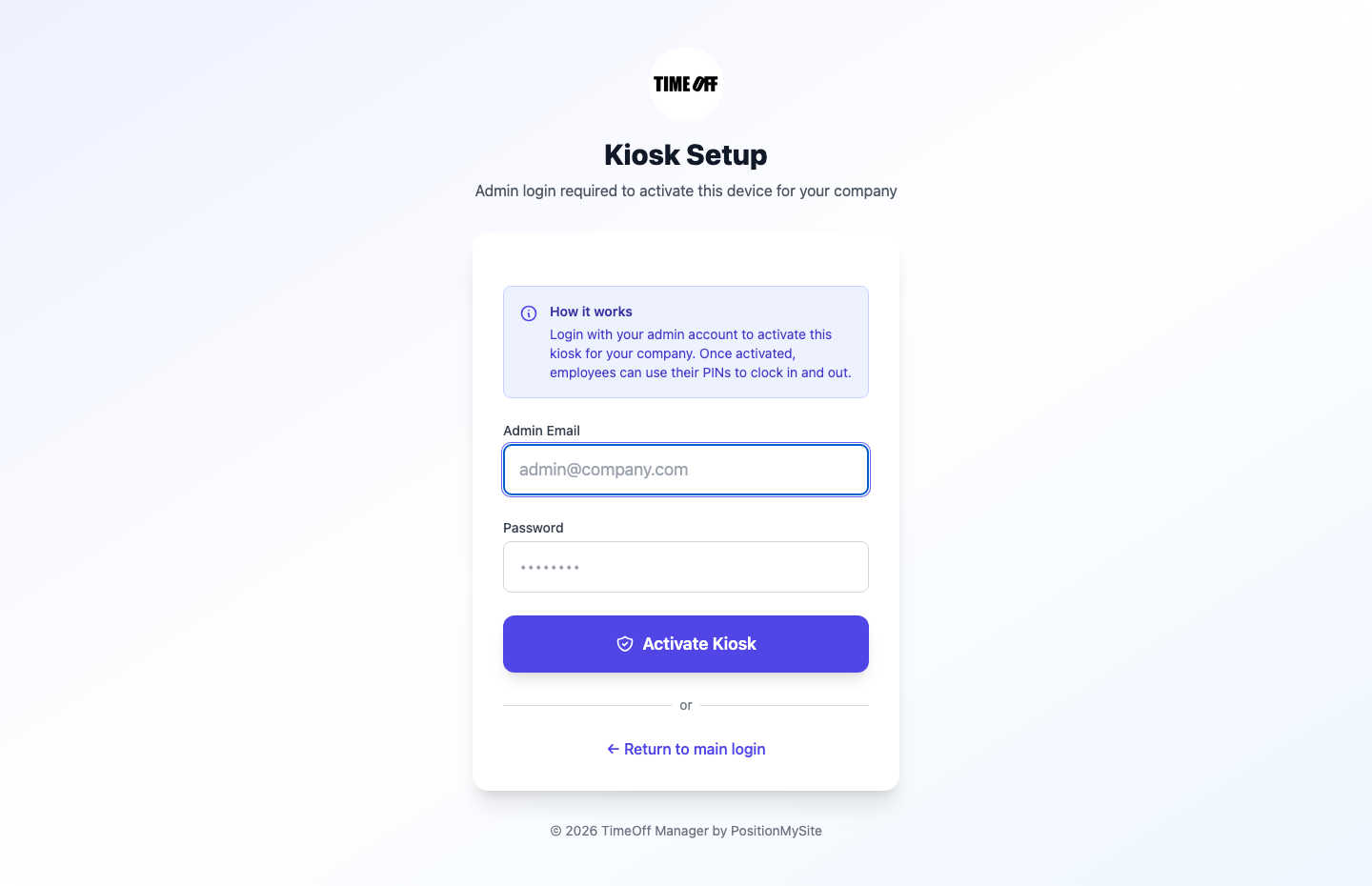
On a shared tablet (TimeOff Kiosk). An admin activates the device once at /clockin. After that, people use their employee PIN—no full login on a shared screen. GPS and selfie still follow Clock rules. This is the door / warehouse / trailer clock, not the leave-and-mileage app. See kiosk overview.
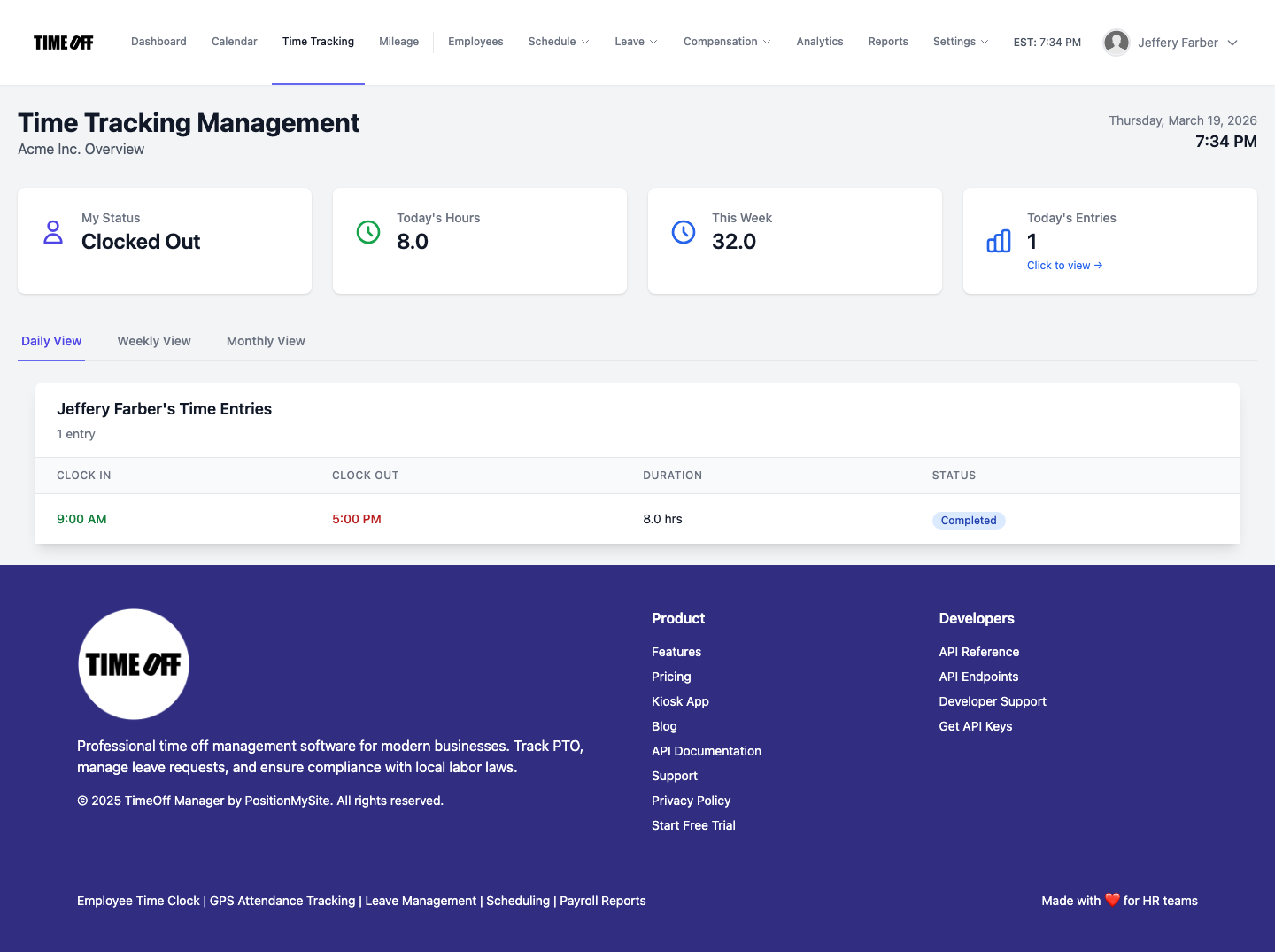
On the web timesheet. When time tracking is on, employees can use /timesheet/employee for status, today’s hours, and entries (including photo/GPS metadata when captured). If the company requires a schedule to clock in, an unscheduled day shows a clear message—admins control that under Company settings → Clock rules.
Managers and admins. Review clock-ins and exceptions from the manager/HR timesheet hub and the dashboard Approval Center (leave, forgot-punch, mileage, day notes in one inbox). For live location during shifts—not the same as GPS-on-clock-in—use the live staff map at /admin/live-map. Employees do not get that map. GPS history for the map is a short rolling window (currently about 10 calendar days), not forever storage.
Geofencing and work locations (without overcomplicating it)
Geofencing only helps if your sites are real rows in the product. Admins maintain offices and job sites under Work Locations: address, coordinates, optional radius, and whether GPS validation applies. Schedulers attach those locations to shifts so “on site” means a place you defined—not a vague city pin.
Keep two ideas separate:
- GPS on clock-in / geofence at clock-in — validates the clock-in against a site when Clock rules say so.
- Live staff map — shows who is inbound or at work during a live-location window. You can run one without the other.
Tell staff what you record. Use your monitoring notice so GPS is a published policy, not a surprise.
Practical steps to roll out a GPS clock this month
- Turn on time tracking in setup or company settings if it is not already on.
- Add work locations for every site that matters, with GPS flags only where you need them.
- Set Clock rules — GPS on clock-in, selfie, schedule-required-to-clock, live location—only what you will actually enforce.
- Pick the device pattern: Pro on personal phones for field crews; Kiosk tablets for doors and warehouses. Many teams use both.
- Train the exception path: missed clock-in → Forgot to clock in → manager approves or edits in Approval Center. Do not let people invent side channels in chat.
- Align overtime with overtime admin rules so hours and premium logic match how you pay.
- Export for payroll — TimeOff Manager is built for payroll-ready timesheets and accounting exports. Do not assume a silent “sync” into a named payroll vendor unless your accountant workflow is set up that way.
For the wider picture of leave + clocks + overtime in one workspace, read the PTO, clocks, and overtime product guide.
Compliance notes (not legal advice)
This is not legal advice. Wage-and-hour rules (overtime, break records, who is non-exempt) depend on your jurisdiction. In the US, start with the Department of Labor’s resources on hours worked. In Canada, provincial employment standards set many floor rules. GPS and live location also raise privacy expectations—document what you collect, when, and who can see the live map or history exports.
Software does not make you compliant by itself. Accurate clock-ins and a clear approval trail make audits and disputes shorter.
Related guides on this blog
- Kiosk selfie and buddy-punch prevention
- Live staff map and inbound geofencing
- Forgot to clock in: fix a missed clock-in
- GPS clock-in for Canada hourly staff
Try GPS time tracking in TimeOff Manager
Primary next step: review TimeOff Manager time tracking—GPS clock-in, geofencing, selfie options, and payroll-ready timesheets for small teams. Prefer clicking around first? Open the live demo, or start a 14-day trial.
FAQ
What is a clock in app with GPS?
It is a time clock on a phone or tablet that records location (when your company requires it) at clock-in and clock-out. Managers see where the clock-in happened instead of trusting a typed start time.
Is TimeOff Manager Pro the same as TimeOff Kiosk?
No. Pro is the signed-in app on each person’s phone for clock, leave, mileage, and more. Kiosk is a shared PIN clock after an admin activates a tablet. Mixing them up causes bad rollouts.
Does GPS mean you track employees all day?
Not by default. GPS-on-clock-in validates the clock event. The live staff map is a separate Clock rules option for a live window during shifts. GPS history for the map is a short rolling window, not permanent surveillance.
Can we require a selfie to stop shared-PIN / kiosk selfie fraud?
Yes—selfie on clock-in follows the same Clock rules as GPS. Pair it with Kiosk PINs or Pro login so one person cannot casually clock in for another.
What if someone forgets to clock in?
Use Forgot to clock in, submit the correct times and reason, and let a manager approve or edit in the Approval Center. That keeps the audit trail without rewriting timesheets by hand.
Does this replace separate PTO software?
TimeOff Manager is built so leave and time tracking live in one company workspace. Approved time off and clock-ins stay aligned—see also our PTO software overview.